Get free quotes from septic inspection near you
Takes about a minute. Free, no obligation; providers reply to you directly.
The first time I watched a septic inspector work, I expected something low-key — a guy with a clipboard, a quick peek in the yard, maybe a sniff test. What I actually witnessed was closer to a small excavation project, involving a probe the length of a fishing rod, a camera snaking through underground pipes, and a very calm professional explaining why the sludge layer in the tank was “concerning.” I had no idea what any of it meant. Most people don’t — until they’re standing over their drainfield at 9am during a house closing wondering why everything just got complicated.
Here’s what a septic inspection actually involves, from the moment you book one to when you get the report.
The Short Version:A septic inspection is a multi-step technical evaluation of your entire onsite wastewater system — tank, pipes, distribution box, and drainfield. A credentialed specialist (not a general home inspector) reviews records, opens the tank, measures sludge levels, checks every component, and evaluates the drainfield. Plan for 1-3 hours on-site. It’s not glamorous, but it will absolutely tell you whether you’re buying a working system or a $15,000 surprise.
Key Takeaways
- Septic inspectors evaluate the full system: tank condition, pipe integrity, distribution box, and drainfield health — not just whether it “flushes”
- Sludge exceeding 1/3 of the tank’s total volume is a red flag requiring immediate pumping
- The inspector must locate the tank first — this alone can take 30+ minutes if records are old or inaccurate
- Hire a PSMA-certified or state-licensed septic specialist, not a general home inspector
Before They Set Foot on Your Property
The work starts at a desk, not in your yard. A qualified inspector pulls the system’s permit, design drawings, installation records, and pumping history before arriving. This tells them the system’s age, original design capacity, and whether it’s been maintained.
Nobody tells you this part matters — but it does. An older system that’s never been pumped and has no maintenance records is a different inspection than a 10-year-old system with clean annual logs. The paper trail sets the baseline.
If records are incomplete or the original as-built drawings are wrong (which happens constantly with older properties), the inspector has to find the tank the hard way.
Step One: Find the Tank
This sounds obvious. It is not.
On properties with old or missing records, locating the tank requires electronic locators or a radio transmitter — literally flushed down the toilet, then tracked from above. The inspector walks a grid pattern across your yard with a receiver until the signal pings. On some properties this takes 10 minutes. On others, it’s half the job.
Pro Tip:Before your inspector arrives, dig out whatever property records, survey maps, or prior inspection reports you have. Even a hand-drawn sketch from a previous owner saves significant time.
Step Two: Open and Assess the Tank
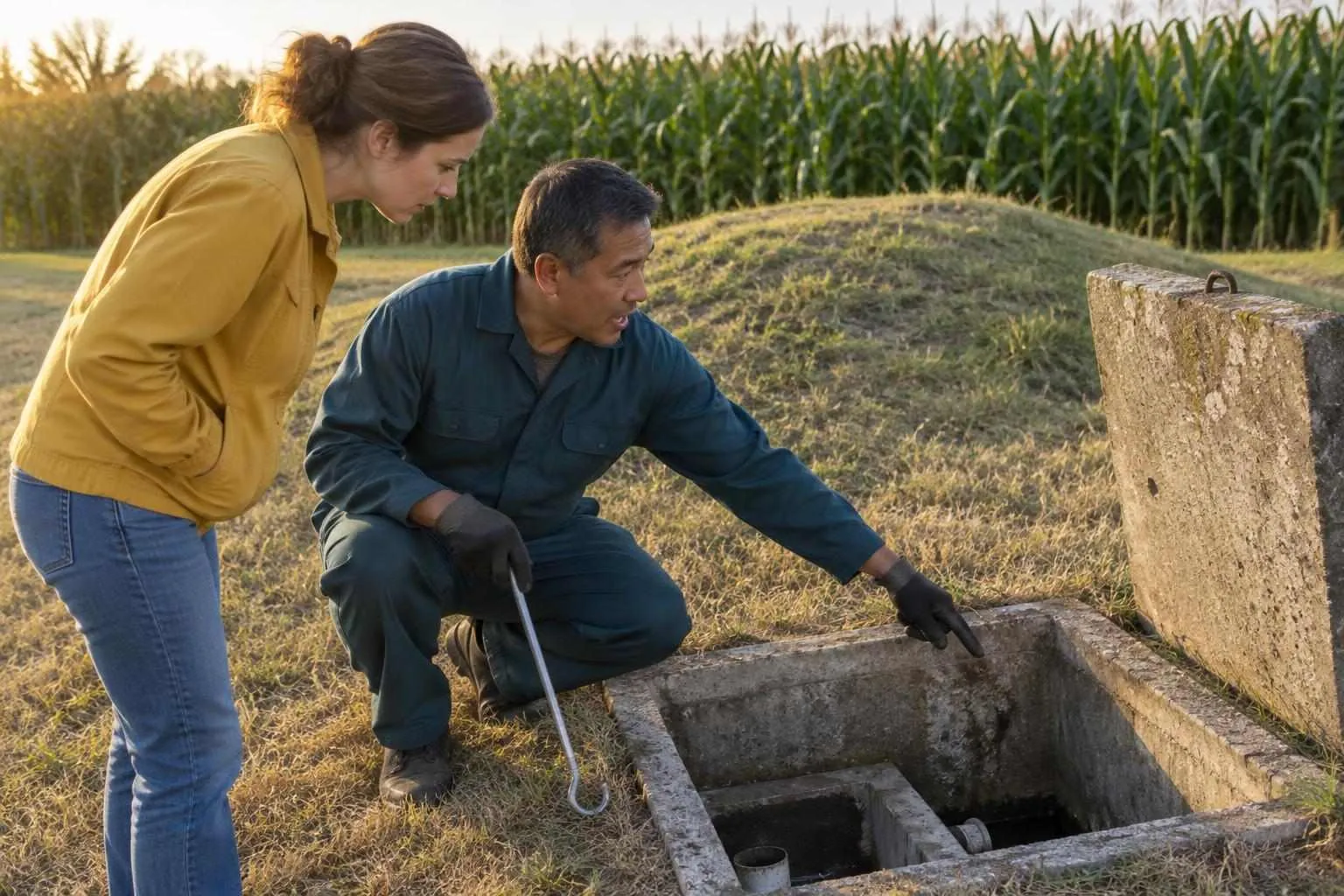
Once located, the tank lid comes off. This is where specialized tools earn their keep.
The inspector uses a Sludge Judge — a clear acrylic tube that’s lowered into the tank to pull a sample and measure the distinct layers: liquid wastewater in the middle, floating scum layer on top, settled sludge on the bottom. There’s a specific threshold that determines whether pumping is needed: sludge should not exceed 1/3 of the tank’s total volume, and it shouldn’t rise to the level of the baffles.
Thick sludge of 6-10 inches is a sign of improper prior pumping — someone didn’t go deep enough, or the tank hasn’t been serviced in too long. Left unchecked, this causes backups.
The inspector also checks:
- Baffles (inlet and outlet) for cracks or deterioration
- Liquid level — low levels suggest a possible leak; high levels suggest a drainage problem
- Primary and secondary chambers in two-compartment tanks
- Structural condition — cracks, corrosion, evidence of infiltration or exfiltration
Reality Check:A general home inspector is not equipped for this. They’re not trained to evaluate sludge levels, baffle integrity, or drainfield distribution patterns. Hiring a specialist isn’t optional — it’s the only way to get a real answer.
Step Three: Pipes, Distribution Box, and Electrical
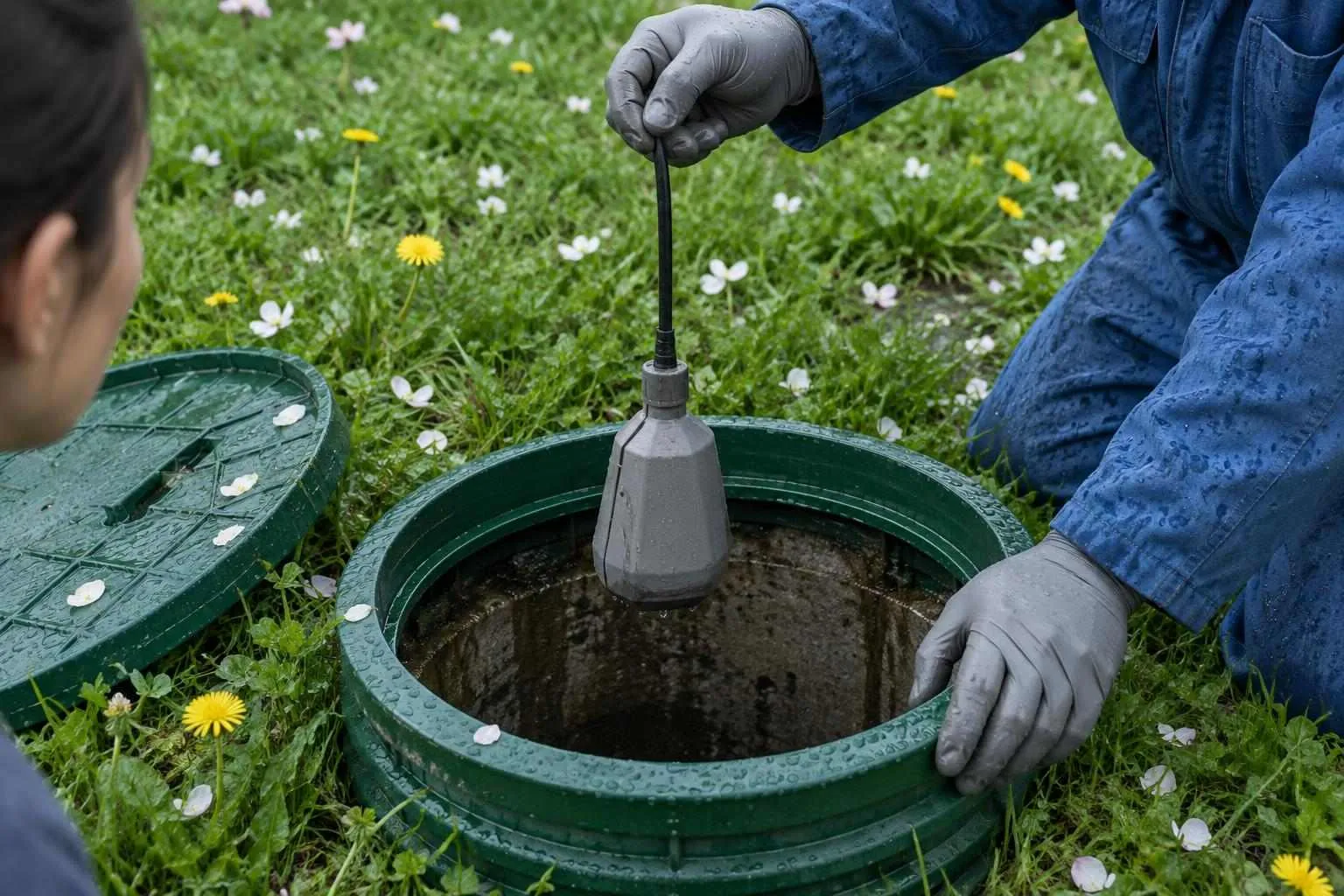
If the system includes a pump (common in systems where gravity drainage isn’t feasible), the inspector verifies electrical connections, pump operation, floats, and controls. A failed float switch or corroded wire is a cheap fix — but only if you catch it before the pump burns out.
The distribution box (or D-box) gets checked for even flow distribution across the drainfield laterals. Uneven flow means some areas of the drainfield are being overloaded while others sit idle — a setup for premature failure.
Pipes get camera inspection: a snake-mounted camera travels through the lines to look for blockages, root intrusion, or pipe collapse. This is the part that finds problems invisible to the naked eye.
| Inspection Component | What’s Being Checked | Tools Used |
|---|---|---|
| Septic Tank | Sludge/scum levels, baffles, cracks, liquid level | Sludge Judge, probe, visual |
| Distribution Box | Even flow, structural cracks, inlet/outlet condition | Visual, flush test |
| Pipes & Laterals | Blockages, root intrusion, pipe collapse | Camera inspection |
| Drainfield | Standing water, ponding, uneven vegetation, odors | Visual, probing, possible excavation |
| Pump & Electrical | Operation, float switches, wiring, controls | Visual, operational test |
Step Four: The Drainfield Evaluation
This is where the inspector earns their fee.
The drainfield is the most expensive component to replace — and the most commonly misread. The inspector is looking for standing water, lush or unusually green vegetation (sewage acts as fertilizer), soggy ground, dark water pooling, or sewage odors. Any of these are red flags.
In some cases, evaluation requires excavating a small test pit to assess soil absorption conditions. This is common in transactions where the drainfield is older or where surface signs are ambiguous.
States like Iowa require point-of-sale septic inspections precisely because drainfield failures routinely go undetected through visual-only assessments — and the downstream consequence is groundwater contamination.
Pro Tip:If you’re buying a home, commission this inspection as soon as you’re under contract. Drainfield issues can affect whether a property is financeable, not just livable.
Safety: What You Don’t See
One detail that rarely shows up in real estate disclosures: septic tanks produce methane. Entry by homeowners or unequipped inspectors is genuinely dangerous — asphyxiation risk is real. Certified inspectors do not enter tanks without proper safety equipment, and they don’t let homeowners hover over an open lid for good reason.
The pumping that often precedes inspection isn’t just logistical — it reduces gas concentration and allows accurate sludge measurement from the surface.
What You Get at the End
A written report documenting:
- System age and design capacity
- Sludge and scum measurements
- Structural condition of tank, baffles, and D-box
- Camera findings for pipes and laterals
- Drainfield status
- Pass/fail verdict and recommended repairs or timeline for replacement
Passing criteria: septic tank, distribution box, and leach field all structurally sound and functioning as designed. A conditional pass means functional but flagged for follow-up. A fail means something needs repair or replacement before the system can be certified.
Practical Bottom Line
If you’re buying a property with a septic system, don’t skip this. And don’t hand it off to a general home inspector who’ll look at the yard, smell the air, and call it done. Hire a PSMA-certified technician or your state’s licensed septic evaluator.
Budget $300-$500 for a basic inspection in most U.S. markets. Expect 1-3 hours on-site. Have property records ready before they arrive.
For the full picture on how to find, vet, and work with a qualified inspector, start with The Complete Guide to Septic System Inspectors. The 26 million U.S. households on septic systems collectively treat billions of gallons of wastewater every year — and most of those homeowners have no idea what’s happening underground until something goes wrong.
Don’t be that homeowner.
Done reading? Get quotes from septic system inspectors near you.
Takes about a minute. Free, no obligation; providers reply to you directly.
Popular cities:
Nick built this directory to help homebuyers and homeowners find credentialed septic inspectors who provide unbiased evaluations — a conflict of interest he encountered firsthand when inspectors tied to pumping companies recommended costly repairs that an independent evaluator later deemed unnecessary.