Get free quotes from septic inspection near you
Takes about a minute. Free, no obligation; providers reply to you directly.
My cousin called me in a panic three days after closing on her first house. The drains were backing up, the yard smelled like a middle school locker room, and the home inspector’s report said — and I’m quoting directly — “septic system appears functional.” Forty-two hundred dollars in emergency pumping and drainfield repair later, she learned what “appears functional” actually means: the inspector eyeballed the lid and moved on.
That’s the dirty secret of septic inspections. Most buyers don’t know what a real one looks like. Most sellers don’t want to find out. And most general home inspectors — bless them — will tell you upfront that septic systems are outside their scope, then sometimes inspect them anyway.
So let’s fix that.
The Short Version:A real septic inspection takes 2–4 hours, involves opening the tank, measuring sludge with a sludge judge, running a flow test, and evaluating the drainfield — not a 10-minute visual scan. Hire a licensed, specialized inspector. Expect to pay more than you want to. It will still be cheaper than the alternative.
Key Takeaways
- Conventional septic systems should be inspected every 3 years at minimum — annually before any property sale
- Sludge exceeding one-third of tank volume is a pumping trigger; don’t wait for symptoms
- A full inspection includes flow tests lasting 2–4 hours, camera inspection, dye tracing, and a written report
- General home inspectors are not septic inspectors — InterNACHI explicitly puts septic outside standard home inspection scope
What a Septic Inspector Actually Does
Here’s what most people miss: a septic inspection isn’t a single thing. It’s a layered process that can be as shallow as a surface walkabout or as thorough as a full functional evaluation with pumping, camera work, and dye tracing. The difference between those two isn’t subtle — it’s the difference between catching a problem before you own it and discovering it six months after closing.
A proper inspection follows a logical sequence:
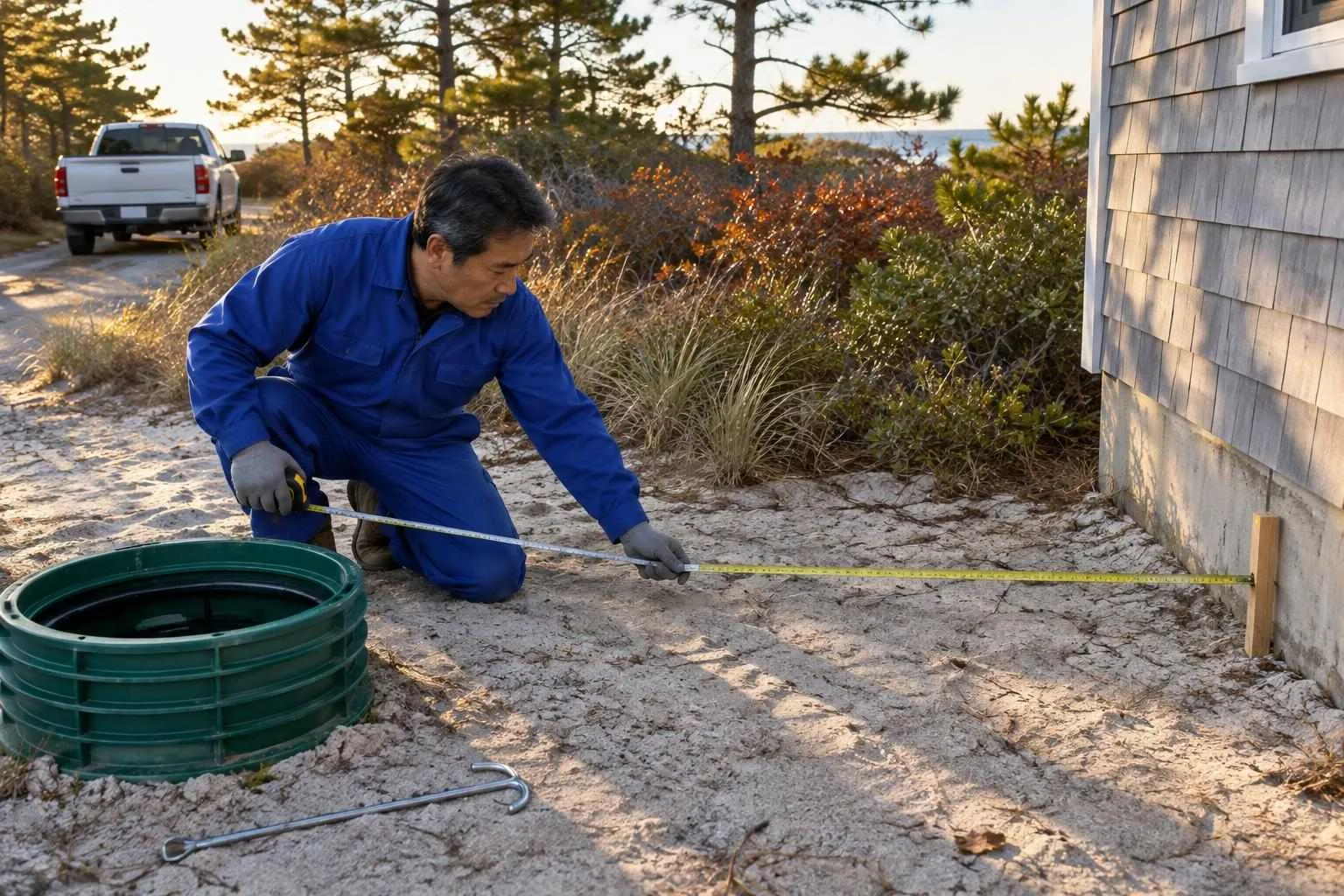
Step 1: Locate the system. This sounds obvious until you’re standing in an unmarked half-acre lot with no as-built drawings. Good inspectors use GPS, probe rods, and municipal records to find the tank and drainfield before anything else. Some states — Rhode Island’s DEM, for example — maintain comprehensive permit records that inspectors can pull for a fee. Others don’t. If your inspector can’t tell you where the drainfield is, that’s a problem.
Step 2: Surface assessment. Before anyone opens anything, the inspector walks the property. They’re looking for wet spots over the drainfield, suspiciously lush vegetation, sewage odors, and any obvious signs of overflow or saturation. This takes maybe 15 minutes. It is not the inspection — it’s the opening act.
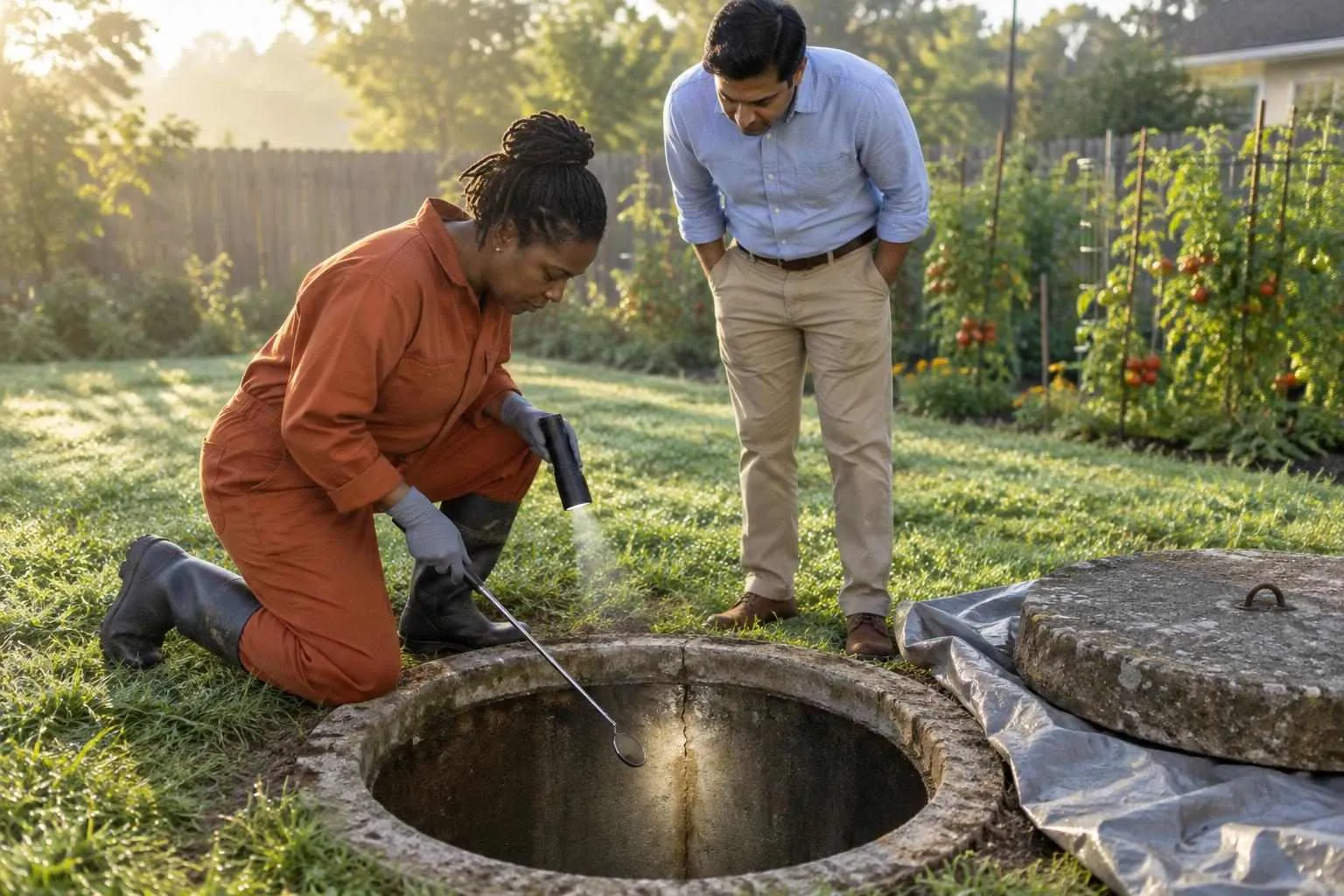
Step 3: Open the tank and check levels. A high liquid level suggests a blockage downstream (drainfield failure). A low level suggests a leak in the tank itself. Both are bad. Neither will show up on a visual inspection through a closed lid.
Step 4: Measure sludge and scum. This is where the sludge judge comes in — a clear acrylic tube that lets the inspector sample the bottom layer of the tank. The rule of thumb: sludge should not exceed one-third of the tank’s total volume, and it should not reach the baffle level. If it has, the tank needed pumping yesterday.
Step 5: Inspect baffles and tees. The inlet and outlet baffles direct flow and prevent solids from escaping into the drainfield. Deteriorated baffles are one of the most common — and most fixable — findings in an inspection. They’re also invisible from the surface.
Step 6: Drainfield evaluation. Standing water, spongy ground, and effluent surfacing are the obvious red flags. But a good inspector goes further — flow testing, dye tracing, and sometimes camera work on the distribution lines.
Step 7: Flow and loading test. Water runs through the system for 2–4 hours, proportional to property size and system complexity. This stress-tests the drainfield under real-world conditions. A drainfield that “looks fine” can fail under load — and this is how you find out before you own the problem.
Step 8: Camera inspection. Fiber-optic sewer cameras let inspectors check pipes for cracks, root intrusion, and offset joints without digging. This used to be specialized; it’s increasingly standard for full inspections. It saves homeowners significant excavation costs when problems are found.
Step 9: Report. A written document covering every finding, with photos, maintenance recommendations, and a clear statement of what needs repair now versus what needs monitoring. If you don’t get a written report, you didn’t get an inspection.
Pro Tip:Ask for the last pump date before you hire anyone. If the homeowner can’t produce records and the inspector doesn’t plan to pump as part of the inspection, your “full inspection” has a significant gap. You can’t properly evaluate sludge levels in a tank that hasn’t been opened in a decade.
Types of Septic Inspections
Not all inspections are created equal — and the terminology varies by state. Here’s how the major types stack up:
| Inspection Type | What’s Included | Best For |
|---|---|---|
| Visual / Basic | Surface walkabout, external checks, lid observation | Routine peace of mind on a recently-serviced system |
| Maintenance Inspection | Tank opening, sludge measurement, baffle check, pump recommendation | Regular 3-year interval maintenance |
| Full / Functional Inspection | All of the above + flow test, dye tracing, distribution box, camera inspection | Pre-purchase due diligence |
| Property Transfer Inspection | Records review, full functional components, pumping, written certification | Real estate transactions (required in many states) |
The distinction between maintenance and functional matters most in real estate transactions. Rhode Island’s DEM framework, for example, explicitly defines these as separate inspection types with different required components. If you’re buying a house and someone offers you a “maintenance inspection,” push back.
Who’s Qualified to Do This
I’ll be honest: this is where things get murky. Licensing requirements for septic inspectors vary dramatically by state. Some states require inspectors to hold a separate license from their general contractor or plumbing license. Some fold septic evaluation into environmental health licensing. A few barely regulate it at all.
The baseline credentials to look for:
NAWT Certified Inspector (CI): The National Association of Wastewater Technicians offers the most widely recognized independent certification for septic inspectors. It requires demonstrated competency in inspection procedures and ongoing continuing education.
State Licensing: California, for example, mandates that septic inspection companies be licensed — solo operators without proper credentials can’t legally perform the work. Check your state environmental agency’s website for what’s required in your jurisdiction.
Pumping License: In most states, the removal of solids from a septic tank requires a licensed pumper, period. An inspector can evaluate — only a licensed pumper can remove. Often these are the same company.
Reality Check:“I’ve been doing this for 20 years” is not a credential. It’s a conversation starter. Ask for license numbers. Verify them. The state environmental agency website takes 30 seconds. That 30 seconds has saved homeowners thousands of dollars.
Nobody tells you this, but InterNACHI — the largest home inspector trade association in North America — explicitly states that septic inspections are outside the scope of a standard home inspection and require special training. That’s the professional association saying: your home inspector probably isn’t the right person for this. Hire a specialist.
Pricing: What You’ll Actually Pay
National averages here are genuinely hard to pin down, because inspection scope, regional markets, and whether pumping is included create enormous variation. What I can tell you:
A basic visual inspection from a generalist runs on the lower end. A full functional inspection with flow testing, camera work, and pumping — the kind you actually want before buying a house — runs significantly more. Add pumping and camera inspection to any base quote.
The cost comparison that matters: a comprehensive inspection before purchase versus emergency drainfield replacement after. Drainfield replacement typically runs five figures. The math is not complicated.
Pro Tip:Always ask whether pumping is included. Many inspectors quote a base inspection fee and then add pumping as a line item. Get the all-in number before you agree to anything.
When to Schedule an Inspection
Every 3 years, minimum, for conventional systems. Some guidelines — particularly for tribal area systems under Indian Health Service recommendations — suggest annual inspections. The right frequency depends on household size, system age, and local regulatory requirements.
Before any property sale. No exceptions. A functional inspection is increasingly required by state law for property transfers anyway. In states where it isn’t required, a buyer’s agent who doesn’t push for one isn’t doing their job.
When you see symptoms. Slow drains, gurgling pipes, sewage odors indoors or out, wet spots over the drainfield, unusually lush grass in one area — any of these warrants a call to a licensed inspector before the situation escalates into an emergency.
Before adding living space. Adding a bedroom, finishing a basement, converting a garage to an ADU — any change that increases wastewater load requires an evaluation of whether the existing system can handle it. Do this before the permits, not after.
The Health Reality Nobody Mentions
Septic tanks produce methane, hydrogen sulfide, and carbon dioxide. These gases accumulate in enclosed spaces. Tank entry without confined-space rescue equipment and proper training has killed inspectors and homeowners alike.
This isn’t a liability disclaimer. It’s why the “DIY septic inspection” content you’ll find on YouTube stops at the surface — the moment you’re removing a lid and leaning over an active tank, you’re in a different risk category entirely.
Licensed inspectors have the equipment, training, and insurance for this work. Homeowners do not. The health hazard argument for professional inspection is not a marketing tactic. It’s real.
Equipment That Separates Good Inspectors from Great Ones
The difference between a thorough inspection and a cursory one often comes down to tools. What to expect from a well-equipped inspector:
- Sludge judge — the acrylic sampling tube for measuring tank solids
- Fiber-optic sewer camera — for pipe inspection without excavation
- Effluent meters — measuring flow rates through the system
- GPS locators — for mapping system components, especially on large or unmapped properties
- Dye tablets — for tracing flow paths and detecting drainfield bypass
An inspector showing up with a flashlight and a probe rod is doing a fraction of the job. Ask about their equipment before you book.
State Regulations: A Moving Target
The regulatory landscape for septic inspections is genuinely fragmented. A few consistent patterns:
Most states require inspections at property transfer. The specific requirements — what type of inspection, who can perform it, what constitutes “passing” — vary. Some states maintain public records of permitted systems; others don’t.
Real estate transactions are increasingly the driver of regulatory tightening. As more states mandate functional inspections before sale, the market for qualified inspectors is growing. This also means the market for unqualified operators claiming to do the work is growing. Credential verification matters more, not less, in a growing market.
Check your state environmental agency for current requirements. This is one area where “I read online that…” is an unreliable guide — regulations change, and the consequences of getting it wrong during a property transfer are severe.
Practical Bottom Line
Here’s what you do with all of this:
If you’re buying a house with a septic system: Require a full functional inspection as a contingency. Not a visual. Not a maintenance inspection. A functional inspection with flow testing, sludge measurement, camera work, and a written report. Budget appropriately and consider pumping included in the scope.
If you own a home with a septic system: Schedule a maintenance inspection every 3 years. Track your pump dates. Keep your records. A system that’s been on a regular maintenance schedule is dramatically less likely to fail catastrophically than one that’s been ignored.
If you’re hiring an inspector: Ask for their license number and verify it with your state environmental agency. Ask what equipment they bring. Ask what the written report covers. Ask whether pumping is included. If they can’t answer these questions clearly, keep looking.
If you see symptoms: Don’t wait for the 3-year clock. Call a licensed inspector now. The difference between a slow drain and a failed drainfield is measured in months and thousands of dollars.
The septic system buried in your backyard is managing waste for your entire household, every day, silently. The inspection that tells you it’s working — or that it’s about to stop — is one of the highest-ROI evaluations in residential property ownership. Don’t cheap out on it. Don’t skip it. And don’t let a rushed 10-minute walkabout pass as due diligence.
Looking for a licensed septic system inspector near you? Browse our directory of certified inspectors or find professionals in your area. For more on what to expect during the process, see our guide to septic inspection costs and how to read a septic inspection report.
Done reading? Get quotes from septic system inspectors near you.
Takes about a minute. Free, no obligation; providers reply to you directly.
Popular cities:
Nick built this directory to help homebuyers and homeowners find credentialed septic inspectors who provide unbiased evaluations — a conflict of interest he encountered firsthand when inspectors tied to pumping companies recommended costly repairs that an independent evaluator later deemed unnecessary.